

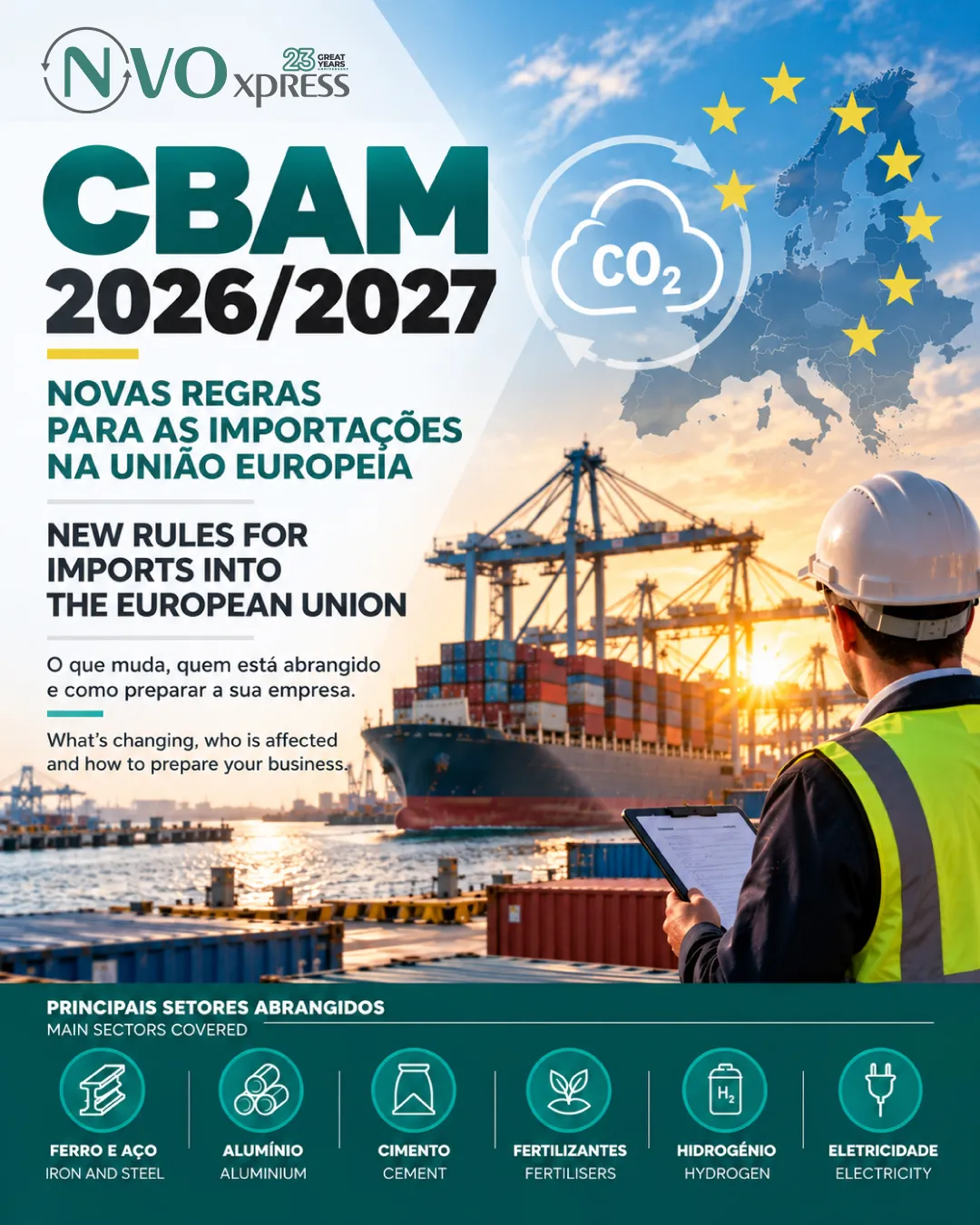
CBAM 2026/2027: How the New EU Rules Could Affect Your Imports
Imports of certain goods into the European Union are now subject to new environmental and customs-related requirements. With the Carbon Border Adjustment Mechanism (CBAM) entering its definitive phase in January 2026, some European importers face additional obligations that may affect their costs, procedures and purchasing decisions.
The impact of these changes goes beyond regulatory compliance. For importers covered by CBAM, the mechanism introduces new responsibilities concerning the collection of carbon emissions data and the assessment of costs associated with international trade operations.
But what exactly is CBAM? Which products are covered? And what obligations should businesses prepare for in 2027?
In this article, we explain the main aspects of the mechanism, the changes introduced in 2026 and the measures that can help businesses anticipate the new requirements.
1. What Is CBAM and Why Was It Introduced?
The Carbon Border Adjustment Mechanism (CBAM) is a European Union instrument designed to place a carbon price on the emissions embedded in certain goods imported from non-EU countries.
Its main objective is to reduce the risk of carbon leakage, which may occur when the production of emissions-intensive goods is relocated to countries with less stringent climate policies.
Within the European Union, several industrial sectors are covered by the EU Emissions Trading System (EU ETS), which establishes a price for greenhouse gas emissions.
CBAM aims to create more balanced competitive conditions between European producers subject to this system and producers of certain imported goods.
It is important to clarify that CBAM is not a traditional customs duty. It is a specific regulatory mechanism involving authorisation, reporting and certificate-purchasing obligations.
2. Which Products Are Covered by CBAM?
At this stage, CBAM covers certain goods belonging to six sectors:
- Iron and steel: including various steel products and certain processed articles.
- Aluminium: covering specific raw materials and aluminium products.
- Cement: including certain categories of cement and related products.
- Fertilisers: certain fertilisers and chemical compounds covered by the regulation.
- Hydrogen: goods classified under the relevant commodity codes.
- Electricity: imports of electrical energy subject to the mechanism.
It is important to emphasise that not all products belonging to these sectors are automatically covered.
CBAM applicability depends on the classification of goods under the Combined Nomenclature codes specified in EU legislation, their origin and any applicable exemptions.
For example, a company importing aluminium products should check the relevant commodity codes rather than assume that all goods manufactured from aluminium fall within the scope of CBAM.
What Should Your Company Do?
Before importing goods, confirm their customs classification and check whether the relevant commodity codes are included within the scope of CBAM.
This assessment is particularly important for industrial companies, raw material distributors and importers of covered components.
3. Are All Importing Companies Subject to the New Rules?
No.
CBAM applies to imports falling within its material and geographical scope, taking into account the exemptions and specific conditions established by EU legislation.
One of the significant changes introduced by Regulation (EU) 2025/2083 was the establishment of a 50-tonne net mass exemption threshold per importer per calendar year.
This threshold applies to the relevant goods covered by CBAM but does not apply to electricity or hydrogen imports.
Importers exceeding the applicable threshold, or otherwise falling within the scope of the mechanism, may be subject to authorisation, reporting and CBAM certificate surrender obligations.
It is also important to understand that the 50-tonne threshold is assessed based on the total quantity of relevant goods imported during the calendar year, rather than separately for each product or supplier.
Practical Example
Consider a Portuguese company importing the following goods during the same calendar year:
- 30 tonnes of steel products covered by CBAM.
- 25 tonnes of aluminium products also covered by CBAM.
In this scenario, the company imports a total of 55 tonnes of relevant goods, exceeding the annual exemption threshold of 50 tonnes.
Consequently, it must assess the obligations applicable to its covered imports, including authorisation and reporting requirements.
This example highlights the importance of monitoring cumulative import volumes throughout the year, particularly when working with multiple suppliers or product categories.
4. What Changed in January 2026?
CBAM was introduced gradually, allowing businesses and authorities to adapt their procedures.
Transitional Period: October 2023 to December 2025
During this phase, importers covered by CBAM were primarily required to report information on the emissions embedded in imported goods.
The objective was to collect data and prepare for the implementation of the definitive mechanism.
Definitive Phase: From 1 January 2026
The definitive phase of CBAM began on 1 January 2026.
This stage introduced additional requirements, including the need for certain importers to obtain authorised CBAM declarant status, subject to the applicable conditions and transitional provisions.
Companies covered by the mechanism must also ensure that information on embedded emissions is collected in accordance with the methodologies established by EU legislation.
However, it is important to distinguish between the start of the definitive phase and the timetable for purchasing and surrendering CBAM certificates.
What Happens in 2027?
According to the timetable established by Regulation (EU) 2025/2083:
1 February 2027 — Scheduled Start of CBAM Certificate Sales
The sale of certificates under the definitive regime is scheduled to begin on this date.
30 September 2027 — First Annual CBAM Declaration
The first annual declaration, covering imports made in 2026, must be submitted by 30 September 2027, together with the surrender of the required certificates.
This distinction is particularly important for businesses.
Imports made in 2026 may generate financial and reporting obligations that must be fulfilled in 2027.
Companies covered by CBAM should therefore not wait until certificate sales begin before preparing their internal procedures.
5. How Could CBAM Affect Import Costs?
For businesses covered by the mechanism, CBAM introduces an environmental dimension into the economic assessment of international trade operations.
Potential costs depend on several factors, including:
- The quantity of goods imported.
- The emissions embedded in the products.
- The applicable calculation methodologies.
- The price of CBAM certificates.
- Any carbon price already paid in the country of origin.
- The adjustments provided for under EU legislation.
Consequently, two companies importing similar products from manufacturers with different emissions levels may face different costs.
CBAM may also generate administrative expenses associated with collecting, verifying and managing environmental information.
Is the Purchase Price Still Enough to Compare Suppliers?
Imagine two quotations for the supply of a particular steel product.
Supplier A offers a lower purchase price, but its production process generates higher emissions.
Supplier B offers a slightly higher price but can demonstrate lower embedded emissions.
For an importer covered by CBAM, the comparison should not be limited to the purchase price and transport costs.
The company must also consider the regulatory obligations and potential costs associated with embedded emissions.
This means that the supplier offering the lowest purchase price may not necessarily provide the lowest total import cost.
Assessing the Total Landed Cost — the overall cost of acquiring and delivering goods to their destination — therefore becomes even more important.
6. Practical Example: A Portuguese Company Importing Steel
Consider a Portuguese industrial company that regularly imports steel products from a non-EU country.
The company uses these raw materials in its production process and intends to maintain its supply arrangements throughout 2027.
Under the new rules, several aspects should be assessed.
First: Confirm Whether the Products Are Covered
The company should verify the customs commodity codes and identify which goods fall within the scope of CBAM.
Second: Assess Annual Import Volumes
It should calculate the relevant quantities to determine whether it exceeds the applicable exemption threshold.
Third: Verify Authorisation Requirements
If covered by the definitive regime, the company must comply with the relevant import requirements, including those relating to authorised CBAM declarant status.
Fourth: Request Information From the Supplier
The company should ensure that it has the necessary information on embedded emissions, in accordance with the applicable methodologies and regulatory requirements.
Fifth: Consider Future Costs
Imports made in 2026 may result in reporting and certificate surrender obligations in 2027.
Sixth: Include These Factors in Purchasing Decisions
Potential CBAM costs should be considered alongside purchase prices, transport costs, customs duties and other import-related expenses.
This example demonstrates that CBAM should not be regarded merely as a customs formality.
For certain businesses, it represents an additional factor in supplier management and financial planning.
7. How Can Your Company Prepare for 2027?
Preparation should begin by identifying operations that may fall within the scope of CBAM.
We recommend that importing companies adopt a structured approach.
1. Review the Customs Classification of Goods
Identify covered products and confirm their Combined Nomenclature codes.
2. Analyse Import Volumes
Review actual and projected import quantities, taking into account the applicable exemption threshold.
3. Confirm Legal Obligations
Determine whether the company requires authorised CBAM declarant status and identify the requirements applicable to its operations.
4. Contact International Suppliers
Request the necessary information on embedded emissions well in advance.
5. Review Total Import Costs
Include potential CBAM-related expenses in purchasing decisions and financial forecasts.
6. Prepare Internal Procedures
Assign responsibilities for information collection, import monitoring and regulatory reporting.
7. Monitor Regulatory Updates
Regularly consult guidance issued by the European Commission and the relevant national authorities.
Early preparation is essential: identifying obligations before importing goods can help businesses avoid administrative difficulties and unexpected costs.
8. The Impact of CBAM on International Logistics
Although CBAM is primarily an environmental and regulatory mechanism, its implementation also has implications for the organisation of international trade operations.
The need to classify goods correctly, coordinate documentation and ensure effective communication between the parties involved reinforces the importance of planning.
Freight forwarders play an important role in coordinating international transport and managing logistics-related information.
However, these responsibilities must be distinguished from the specific legal obligations assigned to importers and authorised CBAM declarants.
Effective communication between importers, suppliers, freight forwarders and customs representatives can help identify potential documentation and operational issues at an early stage.
9. Frequently Asked Questions About CBAM (2026/2027)
What Is CBAM and What Is Its Purpose?
The Carbon Border Adjustment Mechanism (CBAM) is an EU mechanism that places a carbon price on emissions embedded in certain goods imported from non-EU countries. Its purpose is to reduce the risk of carbon leakage and promote more balanced competitive conditions between European and international producers.
Which Products Are Covered by CBAM?
CBAM currently covers certain goods from the iron and steel, aluminium, cement, fertilisers, hydrogen and electricity sectors. Its application depends on the specific customs classification of each product, meaning that not all goods within these sectors are necessarily covered.
Do All Companies Importing Goods Have to Comply With CBAM?
No. CBAM applies only to imports covered by the regulation, taking into account the applicable exclusions and exemptions. A 50-tonne annual threshold per importer applies to certain goods but does not apply to electricity or hydrogen.
When Do Importers Have to Start Paying for CBAM Certificates?
CBAM certificate sales are scheduled to begin on 1 February 2027. The first annual declaration, covering imports made in 2026, must be submitted by 30 September 2027, together with the surrender of the required certificates.
How Could CBAM Increase Import Costs?
CBAM may introduce costs associated with the carbon emissions embedded in imported products, as well as administrative expenses related to regulatory compliance. The financial impact depends on the goods, reported emissions and applicable rules.
How Can I Find Out Whether My Company Is Covered by CBAM?
The first step is to identify the customs commodity codes of imported goods and check whether they are included in CBAM legislation. Annual import volumes, product origin and applicable exemptions should then be assessed. If necessary, consult the relevant customs authority or a specialist customs adviser.
10. Conclusion: Anticipating New Requirements Protects Competitiveness
CBAM represents a significant change for certain companies importing goods from non-EU countries into the European Union.
Since January 2026, environmental compliance requirements have become a more direct part of import planning for some businesses.
In 2027, with the scheduled start of certificate sales and the first annual declaration under the definitive regime, these requirements will acquire an additional financial and administrative dimension.
For importers covered by CBAM, preparing in advance means reducing risks, improving cost control and making better-informed commercial decisions.
NVOxpress: Your Partner in International Logistics
At NVOxpress, we understand the needs of companies operating in international markets and provide transport and logistics solutions tailored to the specific requirements of each operation.
In an environment where international trade increasingly demands planning, coordination and responsiveness, working with an experienced logistics partner can make a difference.
Does your company import goods from international markets?
Disclaimer: This article is provided for informational purposes only and does not replace applicable legislation or specialist customs and regulatory advice.
Official Sources and Further Information
The following official sources provide additional information on CBAM and the applicable European legislation:
1. European Commission — Carbon Border Adjustment Mechanism (CBAM)
Official information on the mechanism, its implementation and regulatory requirements.
https://taxation-customs.ec.europa.eu/carbon-border-adjustment-mechanism_en
2. Regulation (EU) 2023/956 — Establishing the Carbon Border Adjustment Mechanism
The European regulation establishing CBAM and its legal framework.
https://eur-lex.europa.eu/eli/reg/2023/956/oj
3. Regulation (EU) 2025/2083 — Amendments to the CBAM Regulation
Amendments introducing simplification measures, including the exemption threshold and changes to the implementation timetable.
https://eur-lex.europa.eu/eli/reg/2025/2083/oj
4. Portuguese Tax and Customs Authority (Autoridade Tributária e Aduaneira)
Official national information and guidance on customs procedures and applicable regulatory requirements.