

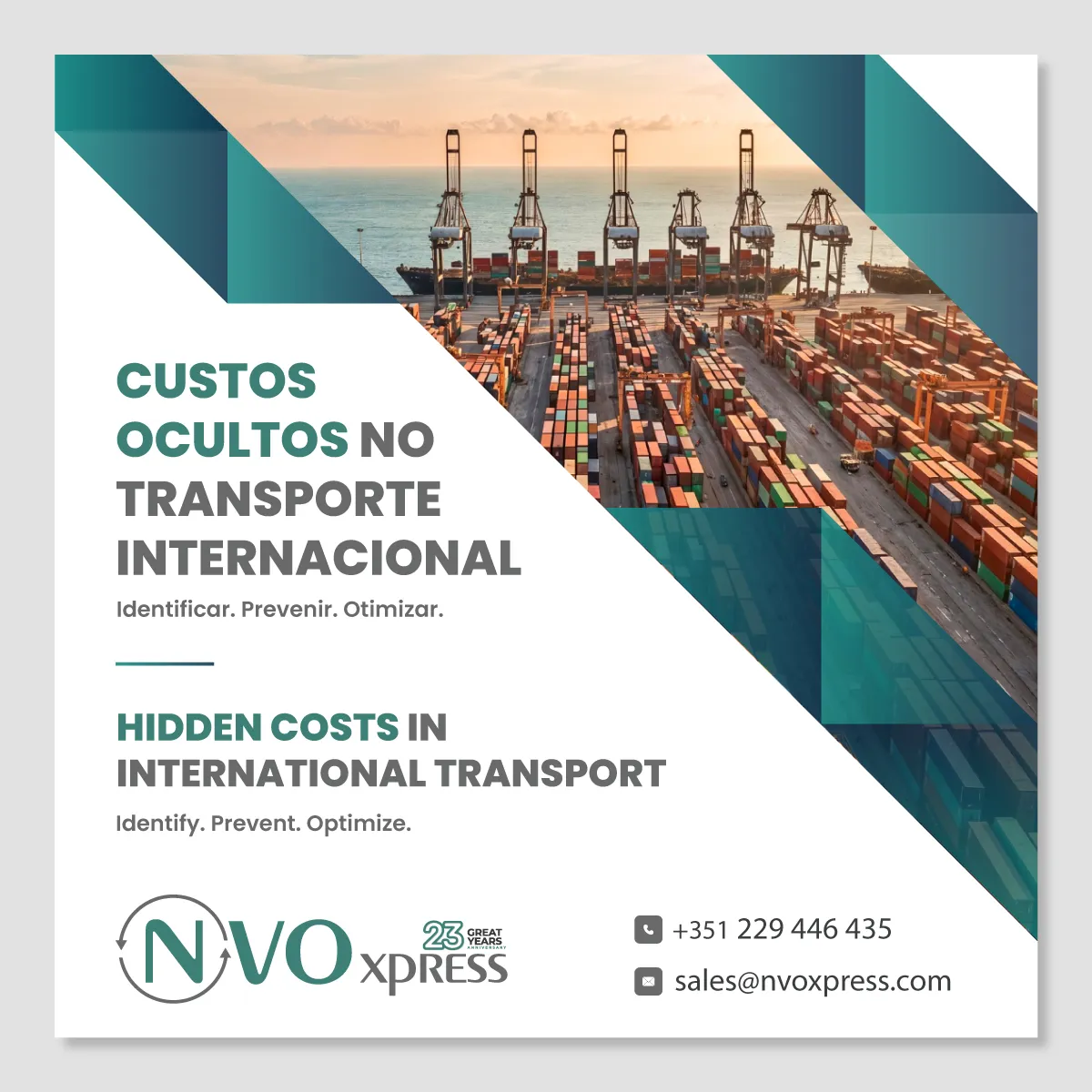
Hidden Costs in International Transport: What Your Company May Be Paying Without Realising
Identify. Prevent. Optimize.
When a company analyses the cost of an international transport operation, it is natural to start with the amount quoted for the transport service.
But the transport price does not always correspond to the true cost of the operation.
Storage, waiting times, additional charges, documentation errors, customs procedures, demurrage and detention, route changes or failed deliveries can turn an apparently competitive operation into a significantly more expensive solution.
There are also less obvious but equally important costs: tied-up capital, stock shortages, production delays, failure to meet customer deadlines or the need to resort to urgent transport solutions.
For this reason, comparing quotations based solely on price can lead to decisions that ultimately increase the total cost of the operation.
Understanding the hidden costs in international transport is essential for better planning, reducing risks and making more efficient logistics decisions.
The Transport Price Is Only Part of the Cost
An international operation involves different components that contribute to the final cost.
In addition to the transport itself, there may be costs associated with origin and destination services, terminals, ports or airports, documentation, customs procedures, storage, insurance, final delivery and other services required to move the goods.
Some are predictable.
Others only arise when there is a delay, a change or a situation that was not anticipated.
It is precisely among the latter that many of the hidden costs of an international logistics operation can be found.
The question therefore stops being simply:
How much does it cost to transport these goods?
And becomes:
What will the total cost of this operation be until the goods reach their destination under the expected conditions and within the required timeframe?
What Are the Main Hidden Costs in International Transport?
Although every operation has its own characteristics, there are additional costs that arise particularly frequently in import and export operations.
Demurrage and Detention
In maritime transport, demurrage and detention can represent significant costs when containers remain at the terminal or outside it beyond the established free periods.
Delays in customs clearance, missing documentation, delivery difficulties or poor coordination between the different parties involved can quickly increase these charges.
A small delay can therefore turn into a considerable cost.
Storage and Terminal Charges
When goods cannot immediately continue to their destination, they may need to remain stored at a port, airport, terminal or warehouse.
The longer the storage period, the greater the potential financial impact.
In certain operations, preparing documentation in advance and properly coordinating the different parties involved can avoid unnecessary days of storage.
Waiting Times
Time also has a price.
Waiting during loading and unloading, delays in making goods available, consignee unavailability or difficulties coordinating delivery can result in additional costs.
In road transport, for example, excessive waiting times can directly result in additional charges.
Documentation Errors or Incomplete Documentation
An incomplete commercial invoice, incorrect tariff classification, inconsistent information or documents that do not arrive on time can cause delays and unexpected costs.
In international operations, the quality of information and documentation is an essential component of logistics efficiency.
Correcting a problem after the goods have reached their destination is generally more complex and expensive than preventing it at origin.
Unexpected Customs Costs
Customs duties, taxes, inspections, controls, specific documentation or regulatory requirements can significantly alter the cost of an import or export operation.
Understanding in advance the requirements applicable to the goods and destination market helps reduce the likelihood of unexpected costs during the process.
Additional Charges and Services
Depending on the mode of transport, origin, destination and conditions of the operation, different additional charges and services may apply.
Terminal charges, handling, documentation, security, fuel, special deliveries and other expenses should be considered when analysing the operation as a whole.
The quotation with the lowest initial price does not always represent the option with the lowest total cost.
Choosing the Wrong Incoterm Can Also Be Expensive
Incoterms® define important responsibilities between buyer and seller, particularly regarding transport, costs, risks and certain formalities associated with the operation.
An unsuitable choice can result in a company assuming costs or responsibilities that were not initially anticipated.
For this reason, the Incoterm should not be regarded simply as a reference included on an invoice or contract.
It should form part of the international operation’s overall strategy.
Understanding who pays for what, who assumes a particular risk and at what point helps prevent unexpected costs and disputes between the parties.
The Invisible Cost of Goods Standing Still
Not every cost appears on a transport invoice.
Imagine raw materials arriving several days later than expected and causing a production stoppage.
Or a product failing to arrive in time to fulfil an important order.
Or goods remaining in transit for weeks while their financial value continues to be tied up.
In these situations, the true logistics impact can be far greater than the additional amount charged by the carrier or terminal.
Goods standing still can represent:
- tied-up capital;
- stock shortages;
- production delays;
- lost sales;
- missed deadlines;
- contractual penalties;
- the need to resort to urgent transport;
- a negative impact on customer relationships.
This is why transit time should also be analysed as a financial variable.
Why Can the Cheapest Transport Option End Up Costing More?
Choosing a logistics solution exclusively on the basis of its initial price can create a false sense of savings.
A cheaper option may involve a longer transit time, more transshipments, lower frequency, less flexibility or greater exposure to certain risks.
If that solution leads to additional storage costs, stock shortages or subsequently requires an urgent shipment, the initial savings can quickly disappear.
The decision should therefore take several variables into account:
Price + Time + Reliability + Risk + Flexibility + Operational Requirements
The objective should not simply be to find the cheapest transport option, but to identify the solution offering the best balance between cost, time and risk.
How Can You Reduce Unexpected Costs in an Import or Export Operation?
Reducing hidden costs begins before the goods start their journey.
Proper planning makes it possible to anticipate many of the situations that commonly result in additional expenses.
Key measures include:
- confirming documentation and customs requirements in advance;
- correctly analysing the origin, destination and characteristics of the goods;
- choosing the most appropriate mode of transport;
- assessing different routes and transit times;
- correctly defining the Incoterms®;
- understanding the applicable free-time periods;
- ensuring coordination between supplier, carrier, freight forwarder, customs and consignee;
- monitoring the operation and responding quickly to deviations;
- assessing the total cost of the operation rather than just the initial price.
The ability to anticipate potential issues is often one of the most effective ways to reduce international logistics costs.
How Do You Calculate the True Cost of an International Transport Operation?
There is no universal formula that applies to every operation.
However, a proper analysis should consider at least four dimensions:
1. Direct costs
Freight, collection, delivery, handling, documentation, insurance and associated services.
2. Customs and tax costs
Duties, taxes, inspections and other applicable charges.
3. Time-related costs
Storage, demurrage, detention, waiting times and tied-up capital.
4. Risk-related costs
Potential delays, stock shortages, production disruptions, lost business or the need for urgent solutions.
This approach makes it possible to compare alternatives much more realistically.
More Information Leads to Better Decisions
Reducing international transport costs does not necessarily mean always negotiating the lowest price.
It means having enough information to choose the most efficient solution for each operation.
An analysis that considers costs, deadlines, risks, documentation, customs requirements and the specific needs of the goods makes it possible to anticipate problems and reduce expenses that might otherwise only be identified when it is already too late to avoid them.
In international logistics, the easiest cost to reduce is often the one we can prevent before it occurs.
Need to Analyse the True Cost of Your International Operations?
At NVOxpress, we analyse each operation considering not only transport, but also the different variables that can influence its cost, timeframe and risk.
If you are planning an import or export operation, provide us with the origin, destination, type of goods, weight or dimensions and required timeframe.
Our team can assess the available alternatives and help you identify a solution suited to the requirements of your operation.
Talk to NVOxpress and turn better information into better logistics decisions.
Frequently Asked Questions
What are the main hidden costs in international transport?
The most common include storage, demurrage and detention, waiting times, terminal charges, documentation costs, customs procedures, inspections, additional deliveries and expenses caused by delays or changes to the operation.
How can I avoid unexpected costs when importing goods?
Planning the operation in advance, validating documentation, analysing customs requirements, choosing the appropriate Incoterm and coordinating all parties involved can significantly reduce the risk of additional costs.
Is the cheapest transport option always the best choice?
No. The initial price should be considered alongside transit time, reliability, risk, flexibility and potential additional costs. A solution that is initially cheaper may ultimately have a higher total cost.
What are demurrage and detention?
These are charges generally associated with the use of containers beyond the established free periods. The specific conditions depend on the operation and the rules applied by the carrier and/or terminal.
How can I determine the true cost of international transport?
You need to consider not only freight costs, but also origin and destination charges, documentation, customs procedures, applicable taxes and duties, insurance, storage, delivery and potential costs associated with the time and risk involved in the operation.