
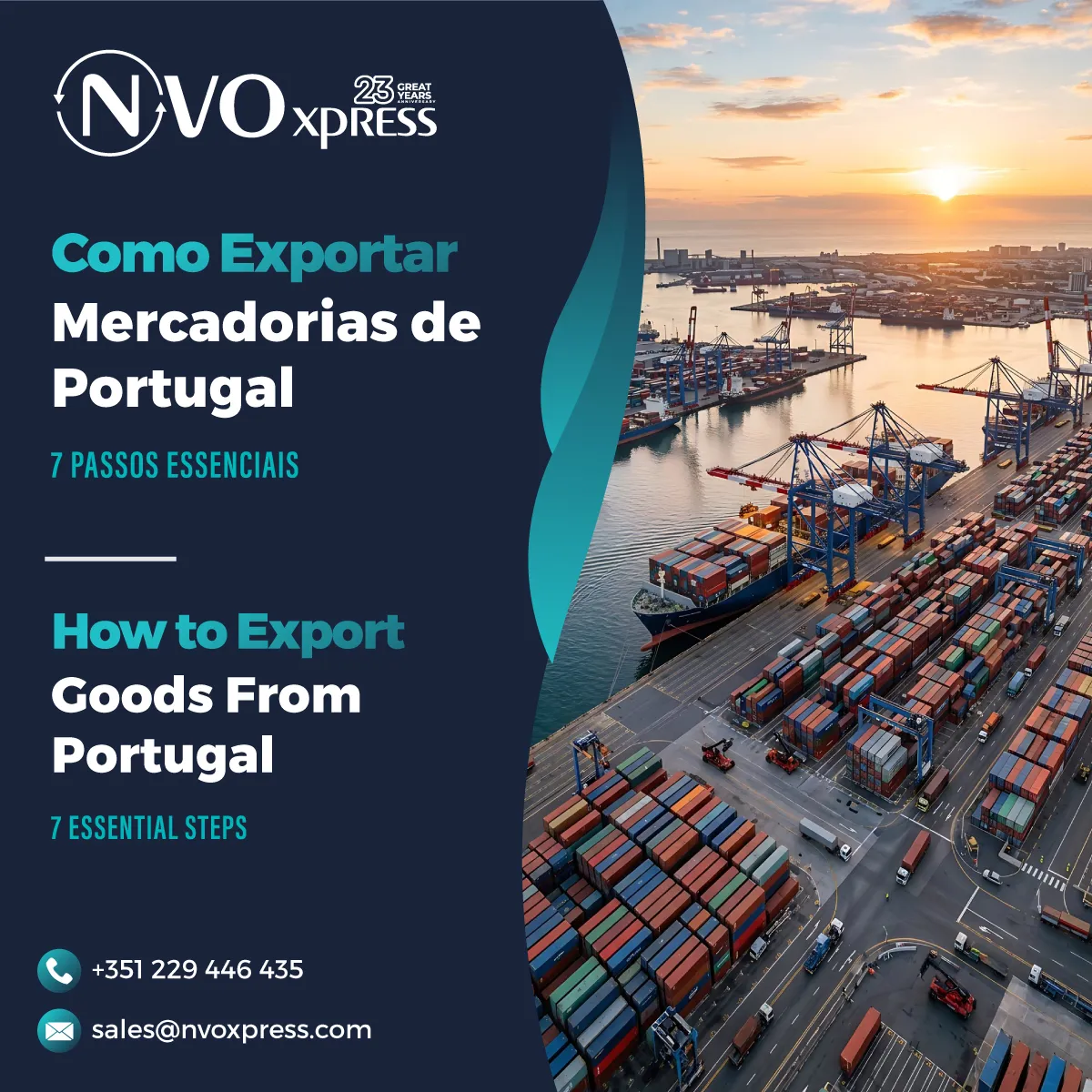
How to Export Goods from Portugal: 7 Essential Steps
From documentation to international transport: a practical guide to preparing your export operations.
Exporting goods from Portugal can open new business opportunities, allowing companies to expand into international markets, diversify their customer base and strengthen their competitiveness.
However, successful export operations require much more than securing an international customer and arranging transportation.
Documentation, customs procedures, Incoterms, transport selection, logistics costs and risk management are all factors that can directly influence the efficiency and profitability of an international shipment.
An incomplete document, an incorrectly defined Incoterm or an unsuitable transport solution can result in unexpected costs, delays and operational difficulties.
For companies planning to expand internationally, understanding how to export goods from Portugal is therefore essential.
In this practical guide, NVOxpress outlines 7 essential steps to help businesses prepare their export operations, anticipate potential challenges and make more informed logistics decisions.
1. Understand Your Destination Market and Export Requirements
Before exporting goods, companies should understand the commercial, regulatory and logistical requirements of the destination market.
Exporting goods to another European Union Member State generally involves different procedures from exporting to a country outside the EU.
For most goods moving between EU Member States, there are no customs export declarations or customs duties. However, specific products and territories may be subject to additional requirements.
When exporting to countries outside the European Union, companies may need to comply with customs procedures, product-specific regulations and import requirements established by the destination country.
What should you check before exporting?
- Import restrictions or licensing requirements.
- Product certification and technical standards.
- Labelling and packaging requirements.
- Applicable customs duties and taxes.
- Rules of origin and preferential trade agreements.
- Documentation required by the destination country.
These requirements may vary according to the product, its classification and the destination market.
Where can you check export requirements?
The European Commission’s Access2Markets portal provides information on tariffs, customs procedures, rules of origin, product requirements and international trade conditions.
Consulting these resources before shipping can help businesses identify potential obstacles and avoid unnecessary delays.
2. Prepare Export Documentation and Customs Procedures
Documentation is one of the most important aspects of international trade.
Errors, inconsistencies or missing information can delay customs clearance, generate additional costs or prevent goods from reaching their destination within the expected timeframe.
The documents required depend on several factors, including the type of goods, destination country, transport mode and applicable customs regime.
Common documents used in international shipments
Commercial Invoice
Identifies the seller and buyer and provides essential information about the transaction, including the goods, their value, currency and agreed commercial terms.
Packing List
Describes how the goods are packed, including the number of packages, weights, dimensions and other relevant shipment details.
Transport Documents
The applicable document depends on the transport mode:
- Bill of Lading (B/L): commonly used in maritime transport.
- Air Waybill (AWB): used in air freight.
- CMR Consignment Note: commonly used in international road freight transport.
Certificates and Other Supporting Documents
Depending on the product and destination, additional documents may be required, such as certificates of origin, sanitary or phytosanitary certificates, export licences or other regulatory documentation.
What is an EORI number?
The Economic Operators Registration and Identification (EORI) number identifies economic operators in their dealings with customs authorities within the European Union.
Businesses involved in customs activities may need an EORI number, depending on their role and the operation concerned.
The European Commission provides further information about the EORI system.
Export declarations and customs clearance
For goods exported from the EU customs territory to third countries, an export customs declaration is generally required, subject to applicable exceptions.
Once the declaration has been accepted and processed, customs systems may generate a Movement Reference Number (MRN), which identifies the customs movement.
Depending on the procedure, proof that the goods have exited the EU customs territory may also be relevant for customs and VAT purposes.
Companies should ensure that the information included in their commercial, transport and customs documents is accurate and consistent.
In Portugal, information on customs obligations and procedures can be consulted through the Portuguese Tax and Customs Authority.
Practical recommendation: Before arranging collection, confirm that all required documents are available and that their information is consistent.
3. Define the Appropriate Incoterms
Incoterms are internationally recognised rules published by the International Chamber of Commerce (ICC).
They help buyers and sellers define their respective responsibilities in international commercial transactions.
The Incoterms® 2020 rules establish how certain obligations, costs and risks are allocated between the parties.
However, Incoterms do not determine every aspect of a sales contract. In particular, they do not automatically establish the transfer of ownership or the payment terms.
Examples of commonly used Incoterms
EXW — Ex Works
The seller makes the goods available at the agreed location, while the buyer assumes extensive responsibilities for the subsequent operation.
EXW may create practical difficulties in international transactions, particularly regarding export clearance.
FCA — Free Carrier
The seller delivers the goods to the carrier or another party nominated by the buyer at the agreed location, under the conditions established by the rule.
FCA can be suitable for several transport modes, including containerised shipments.
FOB — Free on Board
Used exclusively for sea and inland waterway transport.
The seller delivers the goods on board the vessel nominated by the buyer at the agreed port of shipment.
CIF — Cost, Insurance and Freight
Also applicable exclusively to sea and inland waterway transport.
The seller arranges and pays for freight and the insurance required under the rule to the named destination port.
However, the risk generally transfers to the buyer when the goods are on board the vessel at the port of shipment.
DAP — Delivered at Place
The seller arranges transport to the agreed destination and bears the associated risks until the goods are placed at the buyer’s disposal, ready for unloading.
Import clearance and applicable import duties generally remain the buyer’s responsibility.
Why is choosing the right Incoterm important?
An unsuitable Incoterm can lead to misunderstandings regarding:
- Transport responsibilities.
- Customs clearance obligations.
- Allocation of costs.
- Transfer of risk.
- Insurance arrangements.
- Delivery conditions.
It is also important to distinguish between who pays for transport and when the risk transfers.
These are not necessarily the same.
For example, under CIF, the seller pays for freight to the named destination port, but the risk transfers earlier, at the port of shipment.
Additionally, CIF and CIP include specific insurance obligations for the seller, although their minimum insurance requirements differ under Incoterms® 2020.
Practical recommendation: Define the applicable Incoterm and the named place or port clearly in the commercial agreement before arranging transportation.
4. Choose the Most Suitable International Transport Mode
Selecting the right transport solution is a strategic decision that affects costs, transit times and operational efficiency.
There is no single transport mode that is suitable for every shipment.
The best option depends on the characteristics of the goods, their origin and destination, delivery deadlines and budget.
Road Freight
Road transport is particularly relevant for shipments between Portugal and other European markets.
Its main advantages include:
- Flexibility in collection and delivery.
- Door-to-door transport options.
- Suitability for different shipment sizes.
- Integration with European distribution networks.
Road freight may be organised through dedicated vehicles, full truckload services or groupage solutions.
Sea Freight
Maritime transport is frequently used for intercontinental shipments and large cargo volumes.
Depending on shipment requirements, companies may choose between:
FCL — Full Container Load
A full container is allocated to a single shipper’s cargo.
This solution can be advantageous for larger shipments or when greater control over container loading is required.
LCL — Less than Container Load
Cargo from different shippers is consolidated into a shared container.
LCL can be appropriate for smaller shipments that do not justify the use of a full container.
However, LCL is not always cheaper than FCL.
When cargo volume increases, consolidation charges, handling costs and other operational expenses may make a full container more economical.
Air Freight
Air transport is generally associated with shorter transit times and is often considered for:
- Urgent shipments.
- High-value goods.
- Time-sensitive products.
- Cargo requiring rapid delivery.
Although air freight usually involves higher transport costs, it may reduce certain inventory or operational costs in specific circumstances.
Multimodal Transport
Multimodal solutions combine different transport modes within the same logistics operation.
For example, a shipment may involve road transport to a port, maritime transport between countries and final delivery by truck.
The objective is to coordinate the different stages efficiently, balancing cost, transit time and operational requirements.
How should you compare transport solutions?
Before making a decision, consider:
- Total transport cost.
- Estimated transit time.
- Cargo characteristics.
- Required delivery date.
- Reliability of the route.
- Handling and transhipment requirements.
- Potential operational risks.
Practical recommendation: Compare solutions based on the total logistics operation, rather than freight rates alone.
5. Calculate the Real Costs of Your Export Operation
One of the most common mistakes in international trade is evaluating an export operation based exclusively on the initial freight quotation.
The final cost may include several additional expenses, depending on the agreed Incoterm, destination, cargo characteristics and services required.
Which costs should you consider?
Transport Costs
Freight charges associated with the selected transport mode.
Origin and Destination Charges
Costs associated with cargo handling, terminal operations and other services.
Customs-Related Costs
Expenses associated with customs representation, declarations, inspections or other applicable procedures.
Packaging and Cargo Preparation
Costs related to preparing, protecting and securing the goods for international transportation.
Cargo Insurance
Insurance premiums and any additional coverage required for the shipment.
Storage and Waiting Costs
Expenses that may arise when cargo remains at a terminal, warehouse or other facility beyond the expected period.
Demurrage and Detention
In containerised maritime transport, these charges may arise when containers or associated equipment are retained beyond the applicable free-time periods, according to the relevant contractual conditions.
Why is total cost analysis important?
A lower initial freight rate does not necessarily result in a cheaper export operation.
For example, a transport option with a longer transit time may generate additional inventory costs or create difficulties in meeting contractual delivery deadlines.
Similarly, a shipment with an attractive freight rate may involve higher handling or destination charges.
Practical recommendation: Request quotations that clearly identify the services included, potential additional charges and the conditions under which extra costs may arise.
6. Anticipate Risks and Prepare Logistics Alternatives
International transport involves several variables that companies cannot fully control.
Weather conditions, port congestion, customs inspections, operational disruptions and changes in transport capacity may affect shipment schedules.
Although not every incident can be prevented, effective planning can help reduce its consequences.
Common risks in international shipments
- Delays in collection or delivery.
- Port or airport congestion.
- Customs inspections.
- Documentation errors.
- Cargo damage.
- Changes in transport availability.
- Unexpected storage or handling costs.
- Disruptions affecting international transport routes.
How can companies reduce these risks?
Plan Shipments in Advance
Whenever possible, avoid arranging transport at the last minute, especially for operations involving complex documentation or strict delivery deadlines.
Prepare Alternative Solutions
Evaluate whether other routes, transport modes or departure dates could be considered if the original plan becomes unfeasible.
Ensure Documentation Accuracy
Confirm the consistency of shipment information before the goods are dispatched.
Evaluate Cargo Insurance
Transport operators’ liability is not equivalent to comprehensive cargo insurance.
Depending on the applicable transport convention, contractual terms and circumstances, carrier liability may be limited.
Companies should therefore assess whether additional cargo insurance is appropriate.
Maintain Effective Communication
Regular communication between the exporter, logistics provider, carrier and consignee can help identify potential issues before they escalate.
The importance of a logistics contingency plan
A contingency plan does not need to be complex.
It should identify the main risks associated with the shipment and establish practical alternatives.
For example:
- What happens if the scheduled vessel departure is cancelled?
- Is an alternative route available?
- Can the delivery deadline be adjusted?
- Who should be contacted if customs clearance is delayed?
- What procedures apply if the goods are damaged?
Practical recommendation: For time-sensitive or strategically important shipments, define possible alternatives before the transport operation begins.
7. Choose an Experienced International Logistics Partner
Exporting goods involves coordinating multiple activities, stakeholders and operational requirements.
For companies without a dedicated international logistics department, managing these processes can be particularly challenging.
An experienced freight forwarder can help organise the transport operation and coordinate the different stages of the shipment.
What should you look for in a logistics partner?
Experience in International Transport
Knowledge of different transport modes, international routes and operational requirements.
Ability to Coordinate Shipments
Capacity to organise collections, transport connections, documentation and deliveries.
Understanding of Customs Procedures
Knowledge of the documentation and formalities applicable to international shipments, with customs representation arranged where required.
Transparent Communication
Clear information about quotations, transit times, responsibilities and potential additional costs.
Flexibility and Problem-Solving
Ability to assess alternatives when unexpected circumstances affect the original transport plan.
Why can the right logistics partner make a difference?
A logistics partner should do more than arrange transportation.
Its role may include helping exporters evaluate different options, anticipate operational challenges and make informed decisions.
At NVOxpress, we believe that international logistics should support business competitiveness and contribute to the development of international trade.
By approaching transport planning strategically, companies can improve operational coordination and prepare their export operations more effectively.
Frequently Asked Questions About Exporting Goods from Portugal
1. What documents are required to export goods from Portugal?
The documents depend on the destination, type of goods, transport mode and applicable customs procedures.
Common documents include the commercial invoice, packing list and relevant transport document.
Exports to countries outside the European Union generally require a customs export declaration, subject to applicable exceptions.
Additional certificates, licences or supporting documents may also be necessary.
2. Do Portuguese companies need an EORI number to export?
Companies carrying out customs activities in the European Union may need an EORI number.
For exports involving customs declarations, the exporter or other relevant economic operator will generally need appropriate customs identification.
The exact requirements depend on the operator’s role and the customs procedure.
3. Is exporting goods to another EU country the same as exporting outside the EU?
No.
Goods moving between EU Member States generally benefit from the free movement of goods and are not subject to the same export customs procedures that apply to shipments leaving the EU customs territory.
However, specific goods, regulatory obligations and certain territories may require additional formalities.
4. Which Incoterm is best for exporting goods?
There is no universally suitable Incoterm.
The most appropriate rule depends on the transport mode, commercial agreement, responsibilities accepted by each party and the level of control required over the shipment.
The selected Incoterm should always be accompanied by a clearly identified named place or port.
5. Is FCL always more expensive than LCL?
No.
LCL may be more economical for smaller shipments, but FCL can become more cost-effective as cargo volume increases.
The comparison should include freight, handling, consolidation and other applicable charges.
6. Is cargo insurance mandatory for international transport?
Cargo insurance is not universally mandatory for every international shipment.
However, contractual obligations, the selected Incoterm and the characteristics of the goods may influence insurance requirements.
Under Incoterms® 2020, CIF and CIP establish specific insurance obligations for the seller.
Regardless of the applicable rule, companies should assess whether the available insurance coverage adequately protects the value and risks of their cargo.
7. How can companies reduce international shipping costs?
Companies can improve cost efficiency by:
- Planning shipments in advance.
- Comparing transport modes.
- Selecting suitable Incoterms.
- Optimising packaging and cargo consolidation.
- Preparing accurate documentation.
- Anticipating potential additional charges.
- Working with an experienced logistics partner.
The objective should be to optimise the total cost of the logistics operation, rather than simply selecting the lowest freight rate.
Conclusion: Successful Exporting Starts with Effective Planning
Exporting goods from Portugal creates opportunities for companies seeking to expand internationally.
However, successful international operations depend on much more than choosing a destination and arranging transportation.
Understanding market requirements, preparing accurate documentation, defining the appropriate Incoterms, selecting the right transport solution and anticipating potential risks are essential steps in developing a reliable export process.
Effective export planning helps companies reduce uncertainty, improve cost control and make more informed logistics decisions.
The right logistics partner can also contribute to more efficient coordination and support companies throughout their international transport operations.
For businesses preparing to enter new markets or improve existing export processes, investing in logistics planning is an important step towards sustainable international growth.
Planning to Export Goods? Talk to NVOxpress.
Every export operation has its own requirements. Choosing the right logistics solution can make a significant difference in costs, transit times and operational efficiency.
Whether your company is preparing its first international shipment or looking to optimise existing export operations, NVOxpress can help you evaluate suitable international transport solutions.
📦 Tell us about your shipment, its destination and your transport requirements.
Our team can assess your needs and help identify an appropriate logistics solution.
👉 Contact NVOxpress and request a quotation for your next international shipment.