

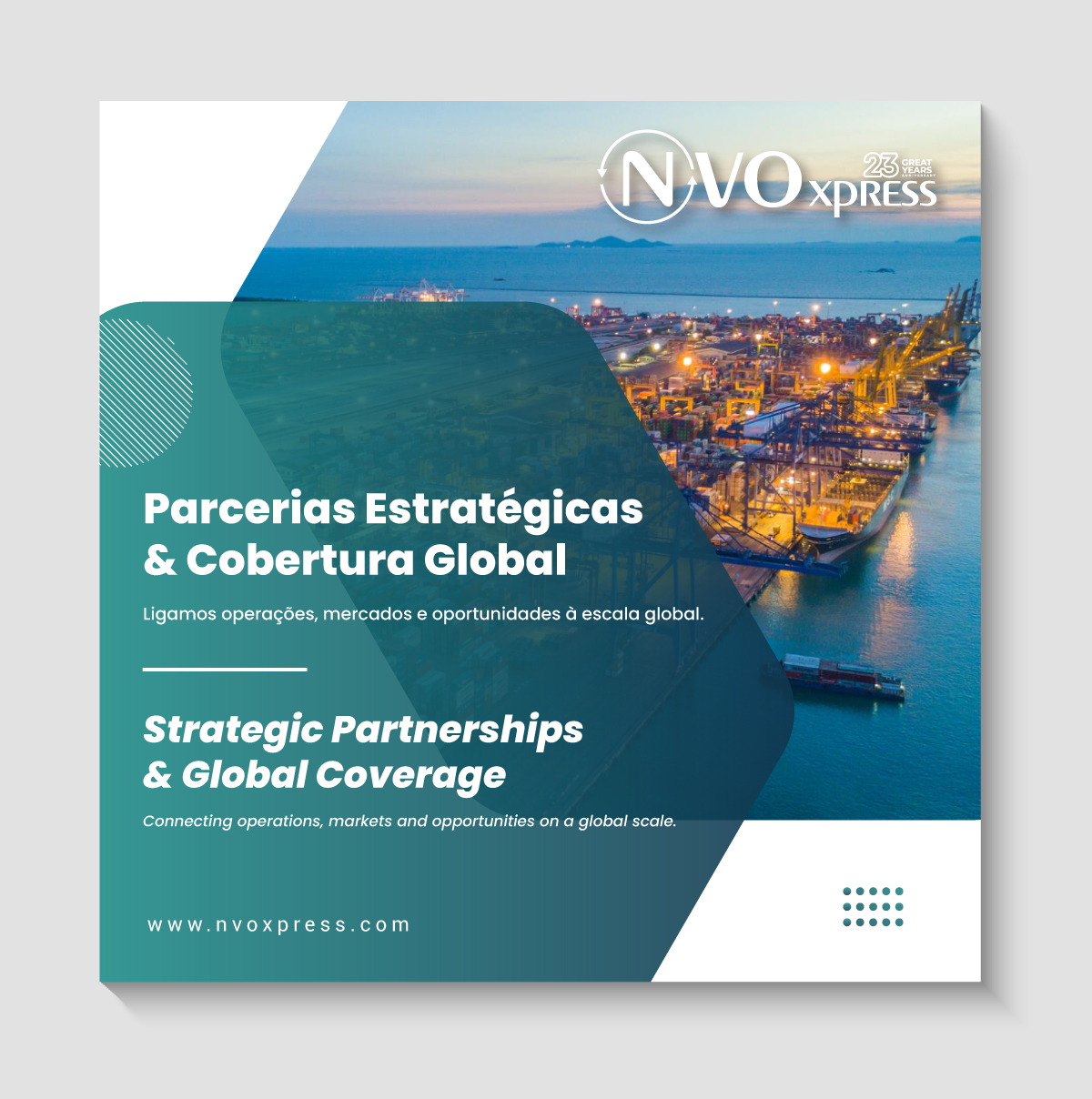
Strategic Partnerships & Global Coverage: Why International Logistics Networks Make the Difference
In international trade, moving goods from point A to point B is only a small part of the process.
Behind every successful logistics operation there is a coordinated network of partners, agents, operators and teams working together to ensure safety, predictability and operational efficiency.
In an increasingly demanding global market, the strength of a freight forwarder is also measured by the quality of its international logistics network.
Much More Than Transportation
When companies export or import goods, they face challenges that go far beyond freight costs:
- different regulations between countries;
- customs procedures;
- operational limitations in specific markets;
- international documentation management;
- risks of delays, disruptions or unexpected costs;
- the need for local operational support in multiple geographies.
This is precisely where strategic international partnerships become essential.
A strong global network allows freight forwarders to access local expertise, operational contacts and faster response capacity in multiple markets, while maintaining close coordination throughout the operation.
The Real Value of an International Logistics Network
Not all international networks provide the same level of quality, control or reliability.
A truly efficient international logistics network should provide:
Efficient Global Coverage
The ability to operate across different continents and markets is essential for companies that depend on international supply chains.
A well‑established international structure provides greater flexibility when selecting routes, operators and multimodal solutions.
Faster Response to Unexpected Situations
Unexpected events are part of international logistics.
Customs changes, port congestion, strikes, operational restrictions or geopolitical developments may directly impact logistics flows.
Having strategic partners on the ground allows quicker decisions, alternative solutions and reduced disruption impact.
Greater Operational Control
A reliable network of partners improves communication between all stakeholders involved in the logistics chain.
This translates into:
- greater shipment visibility;
- improved cargo monitoring;
- more efficient coordination;
- fewer operational failures;
- faster decision‑making.
Local Expertise with Global Coordination
Every market has its own rules, practices and operational requirements.
The support of experienced local partners can make the difference between a smooth operation and one exposed to delays or additional costs.
At the same time, customers continue to benefit from centralized management coordinated by their logistics partner.
Strategic Partnerships & Operational Trust
In practice, an efficient international network is not built solely on commercial relationships.
It is built on:
- long‑term relationships;
- operational alignment;
- technical expertise;
- information sharing;
- trust between teams;
- international experience.
This combination enables more consistent logistics solutions adapted to each client’s real operational needs.
The Importance of an Integrated Vision
Today, companies expect much more than transportation.
They seek partners capable of understanding the impact logistics has on competitiveness, costs, delivery times and customer relationships.
A strong international logistics network provides:
- greater planning capacity;
- improved predictability;
- stronger operational security;
- solutions adapted to different markets;
- greater international growth capability.
International Logistics Requires Coordination
The success of an international operation often depends on the ability to coordinate multiple stakeholders simultaneously.
Carriers, agents, customs authorities, port terminals, airlines, rail operators and local teams must work together efficiently.
The stronger the international logistics network, the greater the operation’s ability to respond and adapt.
Conclusion
In an increasingly demanding and unpredictable global environment, choosing a logistics partner should not be based solely on price.
International experience, coordination capability and the quality of the global network may directly impact operational efficiency, predictability and security.
A strong international logistics network represents much more than global presence.
It represents responsiveness, operational proximity and solutions adapted to the demands of modern international trade.