

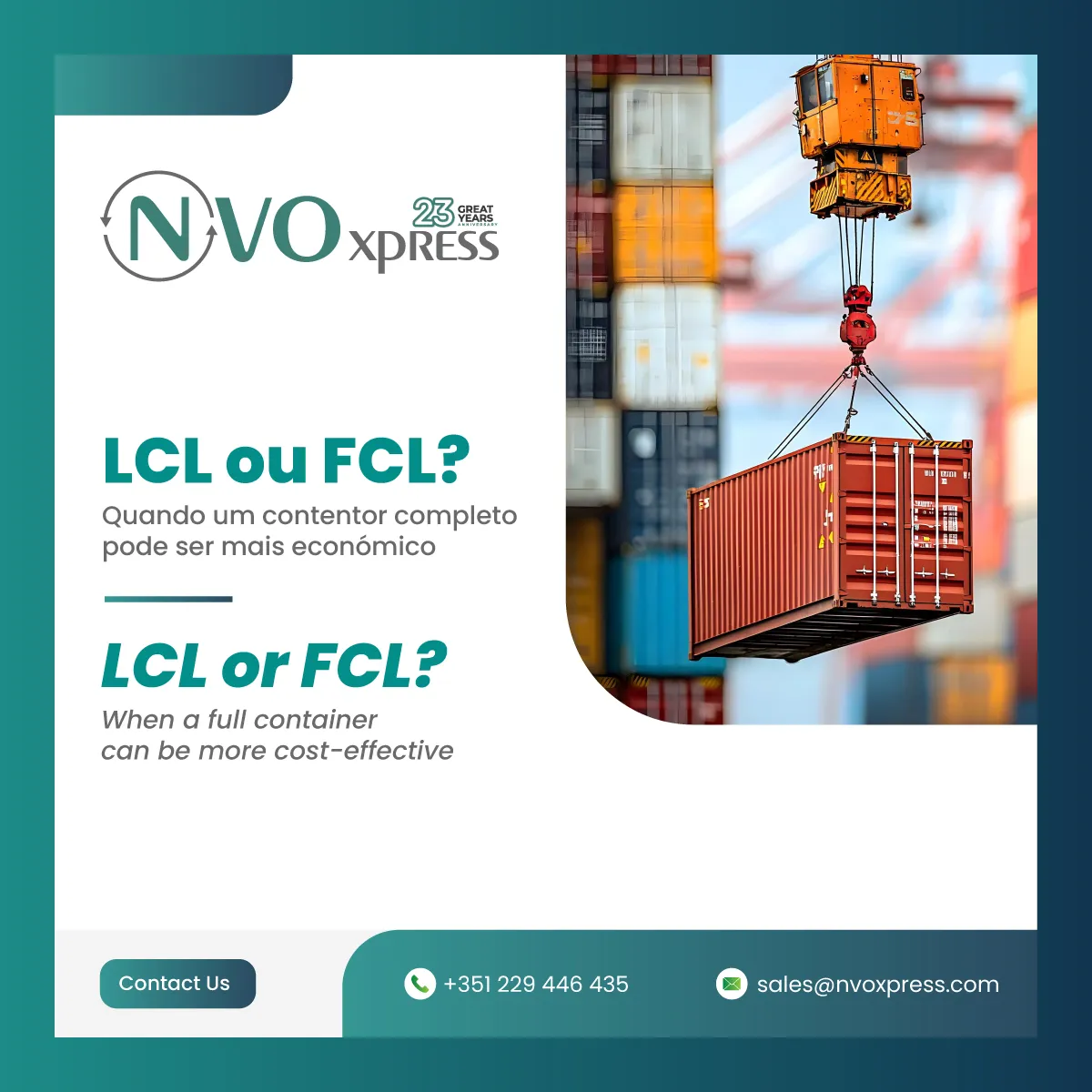
LCL or FCL? When a Full Container Can Be More Cost-Effective
When a company needs to ship goods by sea that do not fill an entire container, the choice may seem obvious: use LCL (Less than Container Load) and pay only for the space required.
But is it always the most cost-effective solution?
Not necessarily.
In certain operations, booking an FCL (Full Container Load) can result in a more competitive total cost, even when the cargo does not use the container’s full capacity.
The explanation lies in a fundamental distinction: the freight rate is not the same as the total cost of the logistics operation.
Volume, weight, consolidation and deconsolidation charges, handling, origin and destination costs, transit time, cargo characteristics and inventory requirements can significantly change the comparison.
Therefore, before deciding between LCL and FCL, the question should not simply be:
“Does my cargo fill a container?”
It should be:
“Which option provides the best overall cost for this shipment?”
LCL and FCL: What Is the Difference?
In containerised ocean freight, two of the most common options are LCL and FCL.
LCL – Less than Container Load
With LCL, several shippers share the same container.
Cargo from different shippers is grouped together through a consolidation process before departure and separated again at destination.
The company uses only part of the available capacity, and the cost is calculated taking into account, among other factors, the volume and/or weight of the cargo and the conditions of the service.
It is particularly suitable for smaller shipments and enables companies to ship by sea without having to wait until they have enough cargo to justify a full container.
FCL – Full Container Load
With FCL, the container is reserved for the cargo of a single shipper.
And this is where an important distinction needs to be made:
FCL does not necessarily mean a full container.
A company can book an entire container while using only part of its capacity.
If the overall cost, speed, reduced handling or other operational factors justify it, FCL may still be the more efficient solution.
How Can a Full Container Be More Cost-Effective?
At first, this may seem contradictory.
If a company only uses part of the container with LCL, how can paying for the exclusive use of an entire container make financial sense?
Because the space occupied is only one component of the total cost.
An LCL shipment generally requires additional processes to combine cargo from several shippers into one container and then separate it again at destination.
Depending on the operation, costs may include:
- Cargo consolidation;
- Deconsolidation at destination;
- Handling and cargo movements;
- Storage;
- Origin services;
- Destination services;
- Terminal charges;
- Inland transportation;
- Formalities and procedures associated with the shipment.
As cargo volume increases, the total cost of an LCL shipment can also increase.
For certain routes and operations, a point can therefore be reached where the cost difference between LCL and FCL becomes significantly smaller — or where FCL becomes more competitive overall.
This is known as the break-even point between the two options.
Is There a Specific Volume at Which FCL Is Always Cheaper?
No.
It may be tempting to establish a rule based on a specific number of cubic metres, but doing so can lead to the wrong decision.
The break-even point between LCL and FCL varies according to several factors:
- Origin and destination;
- Shipping route;
- Container type;
- Cargo volume and weight;
- Current freight rates;
- Local charges at origin and destination;
- Cargo characteristics;
- Shipping frequency;
- The company’s operational requirements.
Consequently, two shipments with exactly the same volume may justify different solutions.
This is why each shipment should be assessed individually rather than relying on a generic rule based solely on cubic metres.
The Freight Rate Is Only Part of the Decision
Imagine two quotations for the same shipment:
Option A — LCL
The initial ocean freight rate is lower.
Option B — FCL
The initial price is higher.
If the comparison ends there, the choice seems obvious.
But then the remaining costs of the LCL operation are considered: consolidation, deconsolidation, handling and other origin and destination services.
The difference between the two quotations begins to narrow.
If we also consider the value of time, the need to have the goods available, the risk of stockouts or the importance of meeting a delivery deadline, the conclusion may change again.
The option with the lowest freight rate may not be the most cost-effective solution for the business.
7 Factors to Compare Before Choosing LCL or FCL
1. Cargo Volume and Weight
These are naturally among the first factors to consider.
For smaller volumes, LCL tends to be a logical and flexible solution.
As volume increases, however, the total cost of both options should be compared.
The key is to identify when paying for consolidation and the services associated with LCL is no longer economically advantageous compared with booking a full container.
2. Origin and Destination Costs
An analysis focused exclusively on the ocean freight rate may overlook a significant part of the operation.
Depending on the route and service, there may be substantial differences in handling, storage, terminal, consolidation, deconsolidation and other charges.
A thorough comparison should therefore assess the shipment from origin to destination.
3. Actual Transit Time
It is not enough to compare the number of sailing days between two ports.
With LCL, the time required for consolidation before departure and deconsolidation after arrival must also be considered.
For some shipments, this can add time to the overall process.
If the goods are needed for production, inventory replenishment or to fulfil a customer order, those additional days can represent a real cost to the business.
4. Number of Handling Operations
LCL generally involves more cargo handling stages.
The goods are received, consolidated with other shipments, loaded and subsequently deconsolidated at destination.
With FCL, the cargo typically remains in the same container for a greater part of the journey.
For fragile, sensitive or high-value goods, reducing the number of handling operations can be a significant advantage.
5. Cargo Characteristics
Not all goods should be assessed solely according to the space they occupy.
Value, fragility, dimensions, weight, packaging and other specific requirements can make one option more suitable than the other.
The question is not simply how much space the cargo occupies, but also what type of cargo is being transported.
6. Shipping Frequency and Inventory Management
There is another decision to consider.
A company may accumulate goods until there is enough cargo for an FCL shipment or make smaller, more frequent LCL shipments.
Waiting for a full container may reduce certain transportation costs, but it can also increase:
- Inventory levels;
- Storage requirements;
- Working capital tied up in stock;
- The time before goods become available.
On the other hand, more frequent LCL shipments may provide greater flexibility and a more regular supply flow.
Logistics costs should therefore be assessed together with inventory costs and the operational needs of the business.
7. Predictability and Operational Risk
The cheapest option is not always the one that provides the greatest predictability.
Depending on the cargo and shipment, reducing additional stages, handling operations or dependencies may justify a price difference.
An efficient logistics decision seeks the best balance between:
Cost + Time + Security + Predictability + Business Requirements.
LCL vs FCL: Quick Comparison
Criteria | LCL | FCL |
|---|---|---|
Container use | Shared | Exclusive |
Small volumes | Generally advantageous | Should be assessed |
Larger volumes | May become less competitive | Tends to become more competitive |
Consolidation/deconsolidation | Required | Usually not required |
Number of handling operations | Higher | Lower |
Flexibility for small shipments | High | Lower |
Operational predictability | May involve more stages | Tends to be higher |
Sensitive or fragile cargo | Requires careful assessment | May offer advantages |
100% container utilisation | Not applicable | Not required |
This comparison is indicative. The most suitable solution always depends on the specific characteristics of each shipment.
LCL or FCL? A Simple Example
Imagine a company that needs to import a volume of goods that is not sufficient to fill an entire container.
The first reaction may be to request an LCL quotation only.
However, there are two possible scenarios.
Scenario 1: the volume is small and the costs associated with LCL clearly keep it as the more economical solution. LCL makes sense.
Scenario 2: the volume is already significant and, once all the costs associated with the operation are considered, the difference compared with FCL becomes small or disappears altogether.
In the second scenario, using an exclusive container may also provide fewer handling operations and greater operational simplicity.
This is precisely why a partial load should not automatically be assumed to require LCL.
LCL and FCL Can Be Part of the Same Logistics Strategy
The choice does not have to be permanent.
A company may use FCL for its regular higher-volume flows and LCL for:
- Intermediate replenishments;
- Smaller orders;
- Samples or product launches;
- Occasional requirements;
- Inventory adjustments.
The shipping method should adapt to the operation — not the other way around.
Frequently Asked Questions
What Does LCL Mean in Ocean Freight?
LCL stands for Less than Container Load. It is a shipping method in which cargo from different shippers shares the same container, allowing companies to transport volumes below the full capacity of a container.
What Does FCL Mean?
FCL stands for Full Container Load. The container is reserved for a single shipper. This does not mean that 100% of its capacity must necessarily be used.
Can FCL Be More Cost-Effective Than LCL?
Yes, for certain shipments. As cargo volume increases and consolidation, deconsolidation, handling and other service charges are taken into account, the total cost of FCL may become similar to or lower than that of an LCL shipment.
Is There a Specific Number of Cubic Metres at Which I Should Choose FCL?
There is no universal threshold. The break-even point depends on the route, origin and destination, weight, volume, current freight rates, local charges and cargo characteristics.
Do I Have to Fill the Container to Book FCL?
No. An FCL container can be booked without using its full capacity whenever this is the more suitable option from an economic or operational perspective.
Is FCL Always Faster?
Not necessarily. However, LCL generally involves additional consolidation and deconsolidation stages. The overall transit time should be assessed for the specific route and service.
How Can I Determine Which Option Is More Cost-Effective?
The comparison should consider the total cost of the operation, not just the freight rate: origin and destination charges, volume, weight, local costs, transit time, cargo characteristics and the specific requirements of the supply chain.
Before Choosing, Compare the Entire Operation
The decision between LCL and FCL should not automatically be based on the amount of cargo available.
A shipment that does not fill an entire container does not necessarily mean that LCL is the most cost-effective solution.
Likewise, booking FCL simply because there is enough cargo does not guarantee that it is the best option.
The decision should result from a combined analysis of cost, time, security, predictability and business impact.
At NVOxpress, we assess the characteristics of each shipment and the available alternatives to identify the solution best suited to each operation.
Do You Have an Ocean Freight Shipment Coming Up?
Send us the origin, destination, volume, weight and cargo characteristics.
We will compare the LCL and FCL alternatives and help you determine which makes the most sense for your shipment — not only in terms of the freight rate, but considering the total transportation cost.