
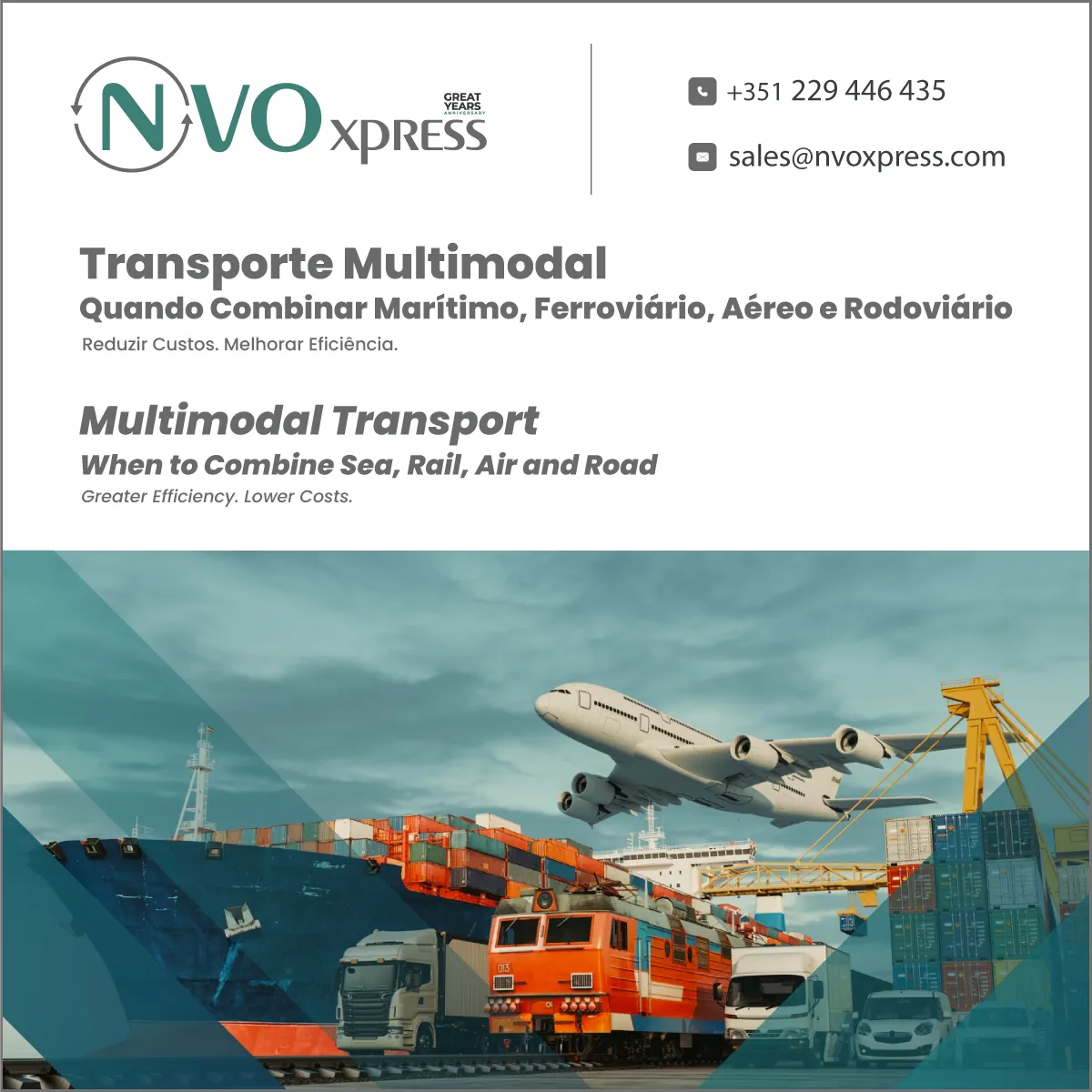
Multimodal Transport: When to Combine Sea, Rail, Air and Road
In an increasingly demanding global market, choosing the right mode of transport can directly impact costs, delivery times and the overall efficiency of the supply chain.
However, the best solution is not always to rely on a single mode of transport.
In many international operations, combining sea, rail, air and road transport makes it possible to create logistics solutions that are more efficient, flexible and tailored to each customer’s specific requirements.
This is the essence of multimodal transport.
What Is Multimodal Transport?
Multimodal transport involves using two or more modes of transport within the same logistics operation, under integrated coordination.
The objective is not to use more transport modes, but to combine those that provide the best balance between cost, transit time, reliability, sustainability and operational efficiency.
Every operation should be assessed individually, taking into account factors such as:
- Type of cargo;
- Destination;
- Delivery deadlines;
- Available budget;
- Legal requirements;
- Customer-specific needs.
When Should You Choose Sea Transport?
Sea freight remains the preferred solution for high-volume cargo and long-distance international shipments.
It is particularly suitable when:
- Cost is the main priority;
- Delivery times are less critical;
- Large cargo volumes are involved;
- The destination is intercontinental.
Despite longer transit times, it continues to offer excellent value for money for many international operations.
When Does Rail Transport Make Sense?
Rail freight is becoming increasingly important, particularly for European connections and selected international freight corridors.
It is especially advantageous for:
- High-volume cargo;
- Regular shipments;
- Medium and long-distance operations;
- Companies seeking more sustainable logistics solutions.
Besides reducing environmental impact, rail transport offers reliable transit times and an excellent balance between cost and efficiency.
When Should You Choose Air Transport?
Air freight is the preferred option whenever speed is essential.
It is recommended for:
- Urgent shipments;
- High-value goods;
- Critical production components;
- Perishable products;
- Small consignments.
Although it involves higher transportation costs, it can significantly reduce the financial impact of delays.
When Should Road Transport Be Prioritised?
Road transport plays a fundamental role in regional distribution and in connecting ports, airports and logistics hubs.
It is particularly suitable for:
- Regional distribution;
- Door-to-door deliveries;
- Domestic and European operations;
- Last-mile logistics.
Its flexibility makes it an essential component of most multimodal logistics solutions.
When Should Different Transport Modes Be Combined?
There is rarely a single transport solution that meets every operational requirement.
In many cases, combining different transport modes delivers the best overall results.
Examples include:
- Sea + Road for imports from overseas markets;
- Sea + Rail to optimise long-distance transport;
- Rail + Road for efficient European distribution;
- Air + Road for urgent deliveries;
- Sea + Rail + Road for large-scale operations requiring cost optimisation and efficient inland distribution.
The objective is always to identify the combination that best fits each logistics operation.
How Can You Choose the Best Solution?
There is no universal answer.
The most suitable solution depends on:
- Type of cargo;
- Destination;
- Delivery deadlines;
- Budget;
- Sustainability objectives;
- Operational risks.
This is where an experienced logistics partner adds real value by analysing every operation and recommending the most efficient transport solution.
Conclusion
Multimodal transport enables companies to combine the strengths of sea, rail, air and road transport, creating logistics solutions that are more efficient, flexible and competitive.
Rather than selecting a single mode of transport, the goal is to build the combination that best supports each operation.
A well-planned multimodal strategy can reduce costs, improve reliability and strengthen overall supply chain performance.